High-Level Synthesis with synthesize()
PowerGridSynth provides a single high-level function, synthesize(), that runs the entire CLC pipeline — topology generation, bus-type assignment, generation/load allocation, dispatch, transmission-line parameterization, and export — in one call.
Two operation modes are supported:
Mode |
Description |
|---|---|
Mode I – Reference-based |
Load an existing pandapower network (e.g. IEEE 118-bus), extract its topological parameters, and generate a structurally similar synthetic clone. |
Mode II – Fully synthetic |
Build a grid entirely from user-specified voltage-level specs (node counts, average degrees, diameters, degree distributions) and inter-level connection parameters. |
For step-by-step control over each pipeline stage, see the other example notebooks: TopologyGeneration, BusTypeAssignment, GenLoadSettings, and ieee_test.
[1]:
from powergrid_synth import synthesize
Mode I — Reference-Based Synthesis
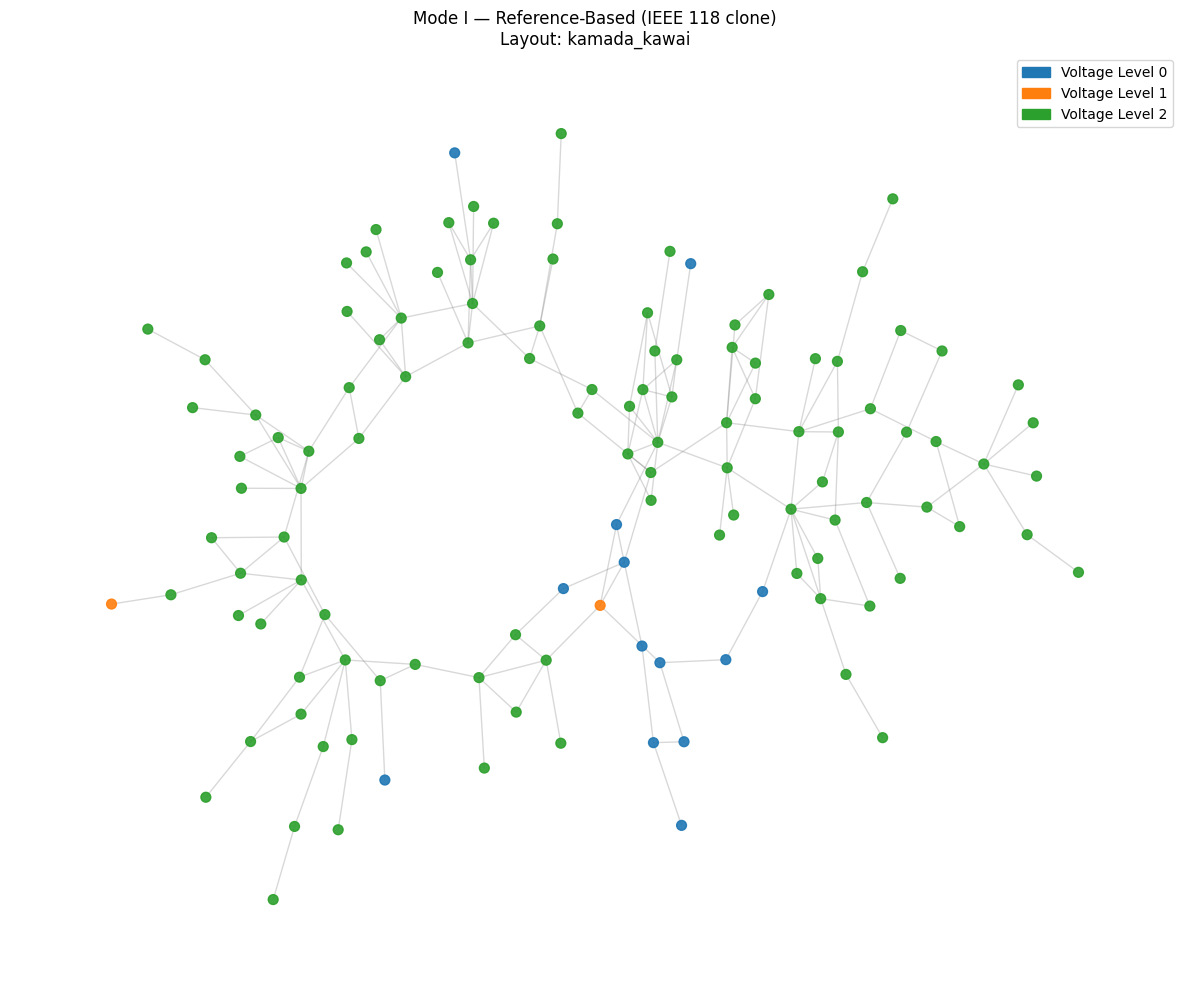
Generate a synthetic grid whose topology statistically mirrors an existing pandapower case. The function extracts degree distributions, diameters, and voltage-level structure from the reference grid, then synthesises a new grid with the same statistical profile.
Key parameters:
reference_case: name of any built-in pandapower network (e.g."case118","case300","case_ieee30")seed: random seed for reproducibilityexport_formats: list of output formats —"json","cgmes","matpower","psse","xiidm","excel", etc.
[2]:
grid_ref = synthesize(
    mode="reference",
    reference_case="case118",
    seed=42,
    output_dir="output/ref_synthesis",
    output_name="ieee118_clone",
    export_formats=["json", "cgmes", "matpower"],
)

print(f"\nSynthesised grid: {grid_ref.number_of_nodes()} nodes, {grid_ref.number_of_edges()} edges")
Extracting topology parameters...
[1] Loaded reference grid: 118 nodes, 179 edges.
--- Starting Generation for 3 Voltage Levels ---
Generating Level 0...
  -> Level 0 Complete. Nodes: 14, Edges: 9
Generating Level 1...
  -> Level 1 Complete. Nodes: 2, Edges: 0
Generating Level 2...
  -> Level 2 Complete. Nodes: 116, Edges: 151
Generating Transformer Connections...
  -> Connecting Level 0 <-> Level 1
  -> Connecting Level 0 <-> Level 2
  -> Connecting Level 1 <-> Level 2
Filtering for Largest Connected Component (LCC)...
  -> Kept 123 nodes (removed 9 isolated nodes)
[2] Topology generated: 123 nodes, 171 edges.
Starting Bus Type Allocation (N=123, M=171)...
  Target Entropy Score (W*): 2.6046, Std Dev: 0.0422
  Iter 0: Best Error = 0.000219
  Converged at iteration 9. Error: 0.000026 < Criteria: 0.000042
[3] Bus types assigned: Gen: 28 (23%), Load: 68 (55%), Conn: 27 (22%)
Allocating Capacity for 28 generators.
Total System Capacity Target: 11168.29 MW using Reference System 1
[4] Generation capacities: total = 10889.0 MW
Allocating Loads for 68 load buses.
Total System Load Target: 8062.86 MW (Level: H)
[5] Loads allocated: total = 8062.9 MW (74% loading)
[6] Generation dispatched: 8042.4 MW (reserve 2846.6 MW)
[7] Transmission lines: 171 lines, avg capacity = 652.2 MVA
-> pandapower JSON export: output/ref_synthesis/ieee118_clone.json
  -> Exported json: output/ref_synthesis/ieee118_clone.json
-> pypowsybl CGMES export: output/ref_synthesis/ieee118_clone_cgmes
  -> Exported cgmes: output/ref_synthesis/ieee118_clone_cgmes
-> pypowsybl MATPOWER export: output/ref_synthesis/ieee118_clone
  -> Exported matpower: output/ref_synthesis/ieee118_clone
[8] Done.

Synthesised grid: 123 nodes, 171 edges
Inspect the synthetic grid
[3]:
import collections

bus_types = [data.get("bus_type", "?") for _, data in grid_ref.nodes(data=True)]
counter = collections.Counter(bus_types)
print("Bus-type breakdown:")
for bt, cnt in sorted(counter.items()):
    print(f"  {bt:12s}: {cnt:4d}  ({cnt/grid_ref.number_of_nodes()*100:.1f}%)")
Bus-type breakdown:
  Conn        :   27  (22.0%)
  Gen         :   28  (22.8%)
  Load        :   68  (55.3%)
[4]:
from powergrid_synth import GridVisualizer

vis = GridVisualizer()
vis.plot_grid(grid_ref, title="Mode I — Reference-Based (IEEE 118 clone)")
Calculating layout 'kamada_kawai'...
Using a custom pandapower network
Instead of a built-in case name, you can pass any pre-loaded pandapowerNet via the reference_net parameter:
[5]:
import pandapower.networks as pn

my_net = pn.case300()

grid_300 = synthesize(
    mode="reference",
    reference_net=my_net,
    seed=123,
    output_dir="output/ref_synthesis",
    output_name="case300_clone",
    export_formats=["json"],
)

print(f"Synthesised grid: {grid_300.number_of_nodes()} nodes, {grid_300.number_of_edges()} edges")
Extracting topology parameters...
[1] Loaded reference grid: 300 nodes, 409 edges.
--- Starting Generation for 13 Voltage Levels ---
Generating Level 0...
  -> Level 0 Complete. Nodes: 18, Edges: 15
Generating Level 1...
  -> Level 1 Complete. Nodes: 89, Edges: 93
Generating Level 2...
  -> Level 2 Complete. Nodes: 21, Edges: 16
Generating Level 3...
  -> Level 3 Complete. Nodes: 135, Edges: 146
Generating Level 4...
  -> Level 4 Complete. Nodes: 2, Edges: 0
Generating Level 5...
  -> Level 5 Complete. Nodes: 23, Edges: 15
Generating Level 6...
  -> Level 6 Complete. Nodes: 1, Edges: 0
Generating Level 7...
  -> Level 7 Complete. Nodes: 5, Edges: 0
Generating Level 8...
  -> Level 8 Complete. Nodes: 1, Edges: 0
Generating Level 9...
  -> Level 9 Complete. Nodes: 23, Edges: 0
Generating Level 10...
  -> Level 10 Complete. Nodes: 13, Edges: 9
Generating Level 11...
  -> Level 11 Complete. Nodes: 3, Edges: 0
Generating Level 12...
  -> Level 12 Complete. Nodes: 15, Edges: 0
Generating Transformer Connections...
  -> Connecting Level 0 <-> Level 1
  -> Connecting Level 0 <-> Level 2
  -> Connecting Level 0 <-> Level 3
  -> Connecting Level 0 <-> Level 6
  -> Connecting Level 0 <-> Level 7
  -> Connecting Level 1 <-> Level 2
  -> Connecting Level 1 <-> Level 3
  -> Connecting Level 1 <-> Level 9
  -> Connecting Level 2 <-> Level 3
  -> Connecting Level 2 <-> Level 5
  -> Connecting Level 2 <-> Level 7
  -> Connecting Level 2 <-> Level 8
  -> Connecting Level 3 <-> Level 4
  -> Connecting Level 3 <-> Level 5
  -> Connecting Level 3 <-> Level 9
  -> Connecting Level 3 <-> Level 10
  -> Connecting Level 9 <-> Level 11
  -> Connecting Level 10 <-> Level 11
  -> Connecting Level 10 <-> Level 12
Filtering for Largest Connected Component (LCC)...
  -> Kept 306 nodes (removed 43 isolated nodes)
[2] Topology generated: 306 nodes, 398 edges.
Starting Bus Type Allocation (N=306, M=398)...
  Target Entropy Score (W*): 2.5866, Std Dev: 0.0248
  Iter 0: Best Error = 0.003512
  Converged at iteration 1. Error: 0.000010 < Criteria: 0.000025
[3] Bus types assigned: Gen: 69 (23%), Load: 171 (56%), Conn: 66 (22%)
Allocating Capacity for 69 generators.
Total System Capacity Target: 30411.36 MW using Reference System 1
[4] Generation capacities: total = 31679.4 MW
Allocating Loads for 171 load buses.
Total System Load Target: 22447.21 MW (Level: H)
[5] Loads allocated: total = 22447.2 MW (71% loading)
[6] Generation dispatched: 22601.9 MW (reserve 9077.5 MW)
[7] Transmission lines: 398 lines, avg capacity = 834.1 MVA
-> pandapower JSON export: output/ref_synthesis/case300_clone.json
  -> Exported json: output/ref_synthesis/case300_clone.json
[8] Done.
Synthesised grid: 306 nodes, 398 edges
Mode II — Fully Synthetic
Build a grid from scratch by specifying the voltage-level topology and inter-level connections.
Key parameters:
level_specs: list of dicts, one per voltage level, each containing:n— target number of nodesavg_k— average node degreediam— target graph diameterdist_type— degree distribution type:"dgln"(Double Generalised Log-Normal),"dpl"(Double Power-Law), or"poisson"
connection_specs: dict mapping(level_i, level_j)tuples to connection parameters:type—"k-stars"or"simple"c,gamma— model parameters
[6]:
# Define 3 voltage levels: backbone, distribution, local
level_specs = [
    {"n": 50,  "avg_k": 3.5, "diam": 10, "dist_type": "dgln"},   # HV backbone
    {"n": 150, "avg_k": 2.5, "diam": 15, "dist_type": "dpl"},    # MV distribution
    {"n": 300, "avg_k": 2.0, "diam": 20, "dist_type": "poisson"}, # LV local
]

# Define inter-level transformer connections
connection_specs = {
    (0, 1): {"type": "k-stars", "c": 0.174, "gamma": 4.15},
    (1, 2): {"type": "k-stars", "c": 0.15,  "gamma": 4.15},
}

grid_syn = synthesize(
    mode="synthetic",
    level_specs=level_specs,
    connection_specs=connection_specs,
    seed=42,
    output_dir="output/syn_synthesis",
    output_name="synthetic_500",
    export_formats=["json", "xiidm", "psse"],
)

print(f"\nSynthesised grid: {grid_syn.number_of_nodes()} nodes, {grid_syn.number_of_edges()} edges")
Generating Level 0: DGLN distribution (Avg=3.5)
Generating Level 1: DPL distribution (Avg=2.5)
Generating Level 2: POISSON distribution (Avg=2.0)
Generating Transformers 0<->1: k-Stars Model
4.15
Generating Transformers 1<->2: k-Stars Model
4.15
[1] Generated synthetic input parameters for 3 voltage levels.
--- Starting Generation for 3 Voltage Levels ---
Generating Level 0...
  -> Level 0 Complete. Nodes: 56, Edges: 70
Generating Level 1...
  -> Level 1 Complete. Nodes: 208, Edges: 166
Generating Level 2...
  -> Level 2 Complete. Nodes: 352, Edges: 331
Generating Transformer Connections...
  -> Connecting Level 0 <-> Level 1
  -> Connecting Level 1 <-> Level 2
Filtering for Largest Connected Component (LCC)...
  -> Kept 442 nodes (removed 174 isolated nodes)
[2] Topology generated: 442 nodes, 583 edges.
Starting Bus Type Allocation (N=442, M=583)...
  Target Entropy Score (W*): 2.5880, Std Dev: 0.0218
  Iter 0: Best Error = 0.002662
  Converged at iteration 9. Error: 0.000007 < Criteria: 0.000022
[3] Bus types assigned: Gen: 104 (24%), Load: 242 (55%), Conn: 96 (22%)
Allocating Capacity for 104 generators.
Total System Capacity Target: 43645.10 MW using Reference System 1
[4] Generation capacities: total = 43931.3 MW
Allocating Loads for 242 load buses.
Total System Load Target: 33788.61 MW (Level: H)
[5] Loads allocated: total = 33788.6 MW (77% loading)
[6] Generation dispatched: 33460.3 MW (reserve 10471.0 MW)
[7] Transmission lines: 583 lines, avg capacity = 728.7 MVA
-> pandapower JSON export: output/syn_synthesis/synthetic_500.json
  -> Exported json: output/syn_synthesis/synthetic_500.json
-> pypowsybl XIIDM export: output/syn_synthesis/synthetic_500.xiidm
  -> Exported xiidm: output/syn_synthesis/synthetic_500.xiidm
-> pypowsybl PSS/E export: output/syn_synthesis/synthetic_500
  -> Exported psse: output/syn_synthesis/synthetic_500
[8] Done.

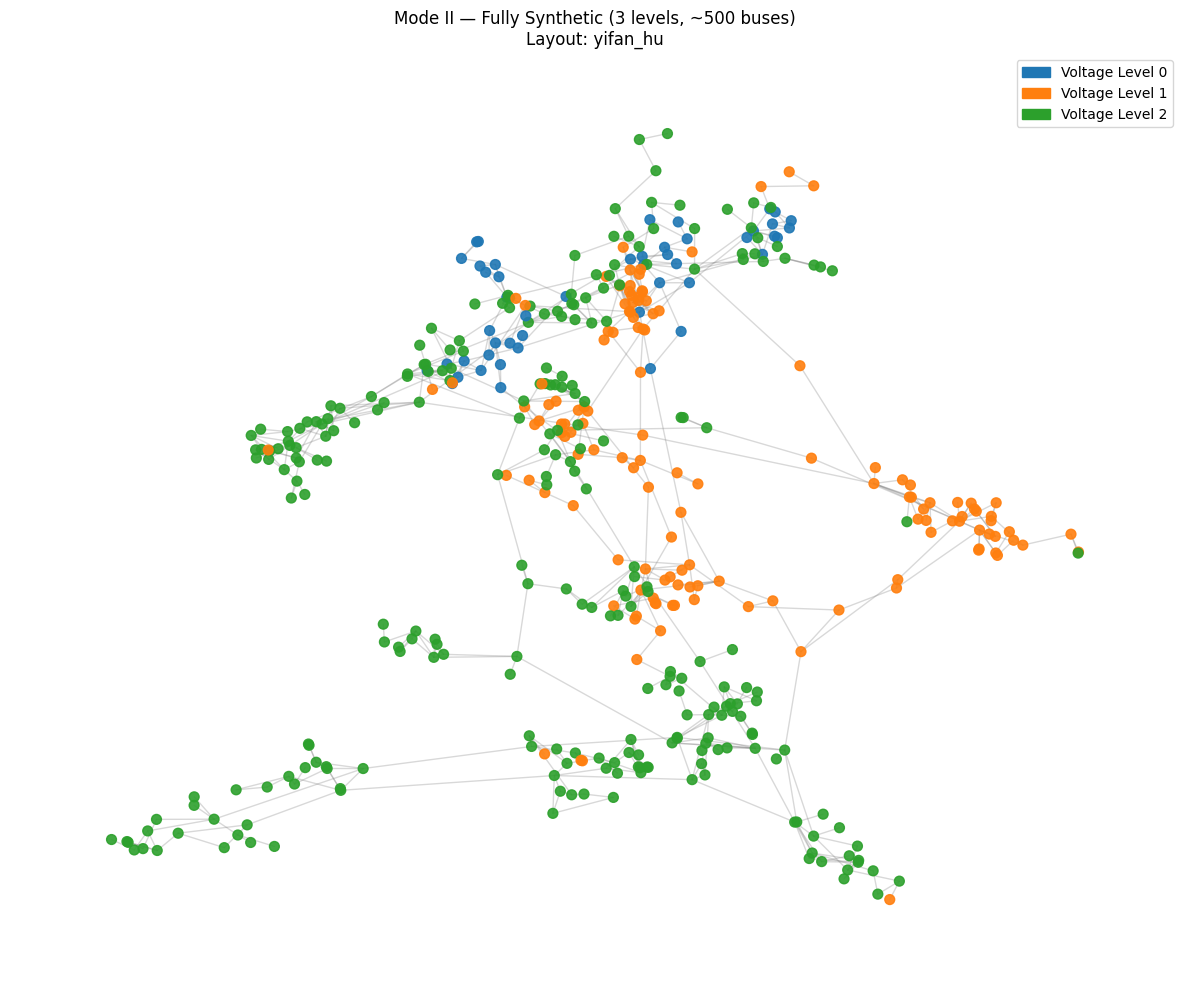
Synthesised grid: 442 nodes, 583 edges
[7]:
vis.plot_grid(grid_syn, layout="yifan_hu", title="Mode II — Fully Synthetic (3 levels, ~500 buses)")
Calculating layout 'yifan_hu'...
/Users/maosheng/kDrive/a_postdoc/CLC_synthesizer/powergrid_synth/core/visualization.py:144: RuntimeWarning: divide by zero encountered in divide
  fr = (k**2 / dist_sq[..., np.newaxis]) * delta
/Users/maosheng/kDrive/a_postdoc/CLC_synthesizer/powergrid_synth/core/visualization.py:144: RuntimeWarning: invalid value encountered in multiply
  fr = (k**2 / dist_sq[..., np.newaxis]) * delta
Tuning Optional Parameters
The synthesize() function exposes all the knobs of the underlying pipeline:
Parameter |
Default |
Description |
|---|---|---|
|
|
Keep only the largest connected component after topology generation |
|
|
Bus-type entropy model (0 = standard, 1 = weighted) |
|
|
Custom |
|
|
Reference system for statistical tables (0–3) |
|
|
Load level: |
|
|
Allow transmission allocator to add/remove edges for DCPF convergence |
|
|
Custom |
Example: medium loading with custom bus-type ratios
[8]:
grid_custom = synthesize(
    mode="reference",
    reference_case="case118",
    seed=99,
    loading_level="M",
    bus_type_ratio=[0.30, 0.50, 0.20],  # 30% gen, 50% load, 20% connection
    output_dir="output/custom",
    output_name="ieee118_custom",
    export_formats=["json"],
)

print(f"\nCustom grid: {grid_custom.number_of_nodes()} nodes, {grid_custom.number_of_edges()} edges")
Extracting topology parameters...
[1] Loaded reference grid: 118 nodes, 179 edges.
--- Starting Generation for 3 Voltage Levels ---
Generating Level 0...
  -> Level 0 Complete. Nodes: 13, Edges: 9
Generating Level 1...
  -> Level 1 Complete. Nodes: 2, Edges: 0
Generating Level 2...
  -> Level 2 Complete. Nodes: 116, Edges: 150
Generating Transformer Connections...
  -> Connecting Level 0 <-> Level 1
  -> Connecting Level 0 <-> Level 2
  -> Connecting Level 1 <-> Level 2
Filtering for Largest Connected Component (LCC)...
  -> Kept 118 nodes (removed 13 isolated nodes)
[2] Topology generated: 118 nodes, 170 edges.
Starting Bus Type Allocation (N=118, M=170)...
  Target Entropy Score (W*): 2.6825, Std Dev: 0.0340
  Iter 0: Best Error = 0.003168
  Converged at iteration 6. Error: 0.000001 < Criteria: 0.000034
[3] Bus types assigned: Gen: 35 (30%), Load: 58 (49%), Conn: 25 (21%)
Allocating Capacity for 35 generators.
Total System Capacity Target: 10631.90 MW using Reference System 1
[4] Generation capacities: total = 10631.9 MW
Allocating Loads for 58 load buses.
Total System Load Target: 5541.81 MW (Level: M)
[5] Loads allocated: total = 5541.8 MW (52% loading)
[6] Generation dispatched: 5520.8 MW (reserve 5111.1 MW)
[7] Transmission lines: 170 lines, avg capacity = 526.5 MVA
-> pandapower JSON export: output/custom/ieee118_custom.json
  -> Exported json: output/custom/ieee118_custom.json
[8] Done.

Custom grid: 118 nodes, 170 edges
Power-Flow Validation
The exported grids can be validated with power-flow solvers from pandapower or pypowsybl.
[9]:
from powergrid_synth import nx_to_pandapower
import pandapower as pp

# Convert to pandapower and run DC power flow
net = nx_to_pandapower(grid_ref)
pp.runpp(net)

print("AC power-flow results (first 10 buses):")
print(net.res_bus.head(10))
AC power-flow results (first 10 buses):
      vm_pu  va_degree         p_mw     q_mvar
0  0.997322  -6.222975    56.335915   0.000000
1  0.991230  -4.279591     0.000000   0.000000
2  0.980314  -6.887049     0.000000   0.000000
3  0.973481 -10.079917     9.358185   0.000000
4  0.982129 -13.812748   109.951167   0.000000
5  0.975794 -13.077277    47.697075   0.000000
6  1.000000   4.888344 -1027.399869 -12.934121
7  0.983676  -7.861924   372.593024   0.000000
8  0.988089  -6.351151     0.000000   0.000000
9  0.989249  -3.365704     0.000000   0.000000
Supported Export Formats
Via |
Formats |
Format Key |
|---|---|---|
pandapower |
JSON, Excel, SQLite, Pickle |
|
pypowsybl |
CGMES, XIIDM, MATPOWER, PSS/E |
|
Pass any combination to export_formats. All output files are written to the specified output_dir.